


Hong Kong Travels: Hong Kong Wetland Park and Fung Lok Wai Fishponds


It is rare for me to go too far from the route between my work in Causeway Bay and my home in Sheung Wan. Even rarer is it for me to leave Hong Kong Island. And it is almost countable on one hand the amount of time I have gone into the New Territories. This isn’t for any particular reason, mind you. It’s just for me to be in the New Territories without good reason. 29th December, I had a good reason.
I chose to visit the Hong Kong Wetland Park in Tin Shui Wai because I thought it was much larger than it turned out to be. If you look at a map, the area to the east of it has miles of fishponds and tributaries leading out into Deep Bay. As it turns out, this is not the case. As it also turns out, this is not a bad thing.
Tin Shui Wai is close enough to the border with China that you can see the skyscrapers looming ominously over the horizon, similar to how it felt in Sha Tau Kok. They line the waterfront on the opposite side of the bay, but they look so ordered and equidistant that it reminds me of a battle formation. They ended up a constant feature of my exploration of the area.
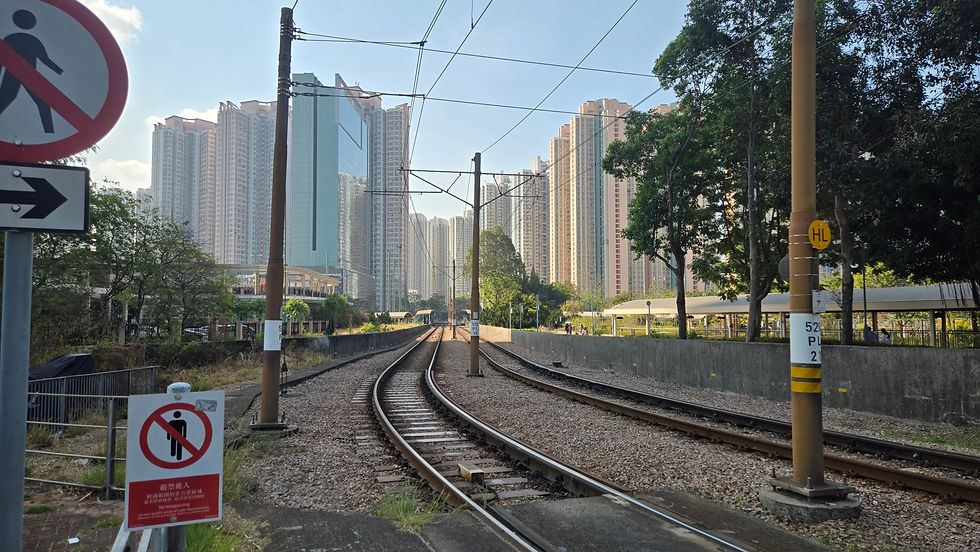
For the town itself, marked further north than the MTR station of the same name, it is characteristically uniform: honeycomb high-rises everywhere illustrate it is primarily a residential district. My feeling is that, if not for the park, there would be no reason for someone to visit there at all, unless required or curious. The large motorways and lack of stops there were on the bus between West Kowloon and Tin Shui Wai (on the 967) doesn’t help to displace this idea. There's even a railway line running between the buildings in the town, although I saw no trains while I was there. Tin Shui Wai feels eager to move people in and out, but only the people in honeycomb high-rises are encouraged to stay.
A short walk under the busy road from the bus stop, accompanied by the echoing sounds of an erhu (if you're lucky), you are greeted by the uniquely designed entrance to the Wetland Park Centre. The entrance is a wide, grey stone path, long enough to require seating and shade on one side. It was early when I arrived, so there were very few other people outside the ticket office. If you choose to visit later, you may encounter waves of children too clueless to avoid running into you as the adults trail behind them.
The high-rises huddled together to watch me go inside, almost as if they were jealous that I could fit through the doors. I was entering a cold stone monolith, until all of a sudden, I wasn’t, and cheerful drawings of animals were telling me fact about themselves on the walls, and even in the bathrooms.

The photography, advertisements, and word-of-mouth won’t mention the constant hum of construction that follows you through the mangrove ponds, and gardens, nor for how close you remain to the rest of the town. A few people have lovely views over the park and fishponds, as it turns out.
Despite this, the park remains a park, and it would be unfair to only criticise things out of the park’s control. There were moments during my time where you could hear the wings of duelling butterflies brush against each other. You can watch a white heron fly low across the water. You can un-focus your eyes and spot tens of mudskippers hopping in and out of their holes, or you can be the only one to spot a dragonfly perching on a reed.
Although the park is not small, the sections are small enough that even as quiet as it was, birdwatchers can still make the lookouts crowded. The telescopes allow you a closer look, but I suspect the cameras and flask-sized lenses are more comfortable to see them through.

It’s a pretty park, and the entrance fee is worth opportunity to see silly mudskippers flop about, and huge dark butterflies swoop out from the tree canopies. It was genuinely sweet to see how even the youngest children were excited to see the tiniest fish, just like I was at the beach when fishing with my grandad.
Personally, I was expecting a much larger space, so as I lay on the grass lawn that forms the sloping roof of the visitor centre, I decided to walk to where I thought the ark continued: the fishponds by Fung Lok Wai.
At first, I wasn’t sure if it was a good idea, because there is no straight road from Tin Shui Wai despite being able to see the ponds from the centre. The quickest way there requires an hour’s walk along a busy motorway and a short slide down a dry, dusty bank into a small industrial park. It was not necessarily romantic, but it did add colour to the impromptu adventure.
You don’t have to leave the asphalt footpaths for more than a few seconds in Hong Kong before you find what ingenious ways people repurpose things. An old suitcase and a child’s pedal car? Part of a wall to a small allotment. Plastic crates? With a little creativity, they become a gate. It takes a second look to see how the chaos is ordered, after which you can have fun seeing what pieces were turned into.

My particular route into Fung Lok Wait took me past an archery range and up slightly, so by the time I found the road again, I was high enough to see all the land stretching back to those same Shenzhen skyscrapers. The birds were loud too, interrupted only by a barking dog and the distant sound of something flat and heavy being moved at a construction site.
Because, indeed, there was construction there too. New apartment blocks (only a few floors high however) are being added to the edge of town, a smaller serving of the much larger projects cloaked in green behind in Tin Shui Wai. I didn’t see much more of Fung Lok Wai as I was focused on the fishponds, but there were a few looks from people who seemed surprised to see me so far out of the way.
The fishponds are large, broad, and seem to continue forever. One you reach the middle road, you could walk straight for more than an hour, never mind if you chose to try different paths. Each pond is separated by a grass bank thick enough to walk along, as worn tracks suggest. The had been more of my expectation for the Wetland Park – an extra square mile or so of wildlife in a peaceful place. Small stout hills grow in stature the farther you look into the horizon, but even so, construction cranes are inescapable. At times, it feels like Hong Kong has a fetish for development.

There are a few – very few- stilted houses with fishing nets hanging outside next to buckets, propane tanks, and rusty bicycles. Each house has a small garden which at times spills out onto the slim path forming a communal vegetable patch. There’s even a sign (in Chinese) which asks people not to take these communal vegetables. A yellowed district map informs you that the district covers the fishponds only, which I imagine makes elections very personal to the twenty or so residents.
I’m starting to worry that too many of these articles end on the same commentary, but if you’ll indulge me one last time, it’s another sign of how Hong Kong has this almost manufactured evolution. The divide between metropolis and farmland can be a single road at times. You can stare through a herd of goats at the warm lights of a city less than ten minutes away, were you allowed to walk in a straight line. It made the moment of peace and quiet that much more important. Herons still fly over water, an old man still lives far off the beaten track, a dog can still sleep in the middle of nowhere and warn me about coming closer.
If you’ve never thought to visit the area and want to spend some time in ordered nature, I’d recommend taking an afternoon to see this less obvious area of Hong Kong.


Comments